
SL.CCS.1/2/3/4 Grades 6-12: An essay of a current news event is provided for discussion to encourage participation, but also inspire the use of evidence to support logical claims using the main ideas of the article. Students must analyze background information provided about a current event within the news, draw out the main ideas and key details, and review different opinions on the issue. Then, students should present their own claims using facts and analysis for support.
FOR THE WEEK OF FEB. 11, 2013
Doctors wave caution flag on teen use of Monster, Rockstar, Red Bull or other energy drinks
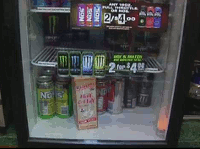



A new medical study of energy drinks raises concerns about how much of those beverages teens can consume safely. Health experts say doctors should tell students that Red Bull, Rockstar, Monster and similar energy-boosters can cause anxiety, difficulty sleeping, high blood pressure and even heart palpitations. A 16-ounce bottle of popular brands has roughly as much caffeine – a stimulant – as two to three cups of coffee. It's also loaded with sugar, researchers write, noting that adolescents who consume energy drinks could be at risk for obesity and dental cavities.
Energy drinks were introduced in the late 1980s and now are heavily promoted to teens via ads, event sponsorships and logo items. The market amounts to more than $5 billion a year, and the study published last week says teen use is up. In 2003, 16 percent regularly consumed the drinks, which rose to 35 percent in 2008. Physicians who studied the issue suggest that pediatricians educate patients and parents on the potential consequences of making energy drinks a regular habit.
In response to last week's report from the American Academy of Pediatrics, an industry group notes that most package labels say the product isn't intended or recommended for children. "Energy drinks, their ingredients and labeling are regulated by the U.S. Food and Drug Administration," says a statement from the American Beverage Association, which claims the pediatricians' article "contains misinformation."
 Sellers say: "Most mainstream energy drinks contain only about half the amount of caffeine of a similar size cup of coffeehouse coffee. . . . Let's stick with the facts, rather than perpetuating sensational untruths which attempt to blur the line between energy drinks and alcoholic beverages." – American Beverage Association statement
Doctor says: "I see them being used more and more, and it's alarming. Teens will come into the office and say they can't sleep and their heart is racing. You'll ask about energy drinks, and they have no idea what's in them." -- Dr. Kwabena Blankson, pediatrician in Portsmouth, Va.
Government official says: "It's a very bad overall message to children that they need to reach for a can of substance to energize. This is not a substance that children need." – Health Commissioner James Tomarken of Suffolk County
Front Page Talking Points Archive
►Social media giants lose two lawsuits blaming them for serious risks to young users
►Wartime news reports fuel fresh strains between U.S. government and the media
►Iran war blocks key Mideast tanker route, pushing up oil prices and endangering global economies
►Measles outbreaks in 30 states reinforce value of childhood vaccines
►U.S. military strikes on Iran bring counter-attacks and congressional pushback
►'The digital Wild West:' Teen social media limits spread in Europe
►Winter Games: Elite athletes show Olympic medal-winning skills in Italy
►Reporters' arrest in Minneapolis church protest raises press freedom issue
►NASA prepares for return to the moon, starting with an orbital mission by four astronauts