

Common Core State Standard
SL.CCS.1/2/3/4 Grades 6-12: An essay of a current news event is provided for discussion to encourage participation, but also inspire the use of evidence to support logical claims using the main ideas of the article. Students must analyze background information provided about a current event within the news, draw out the main ideas and key details, and review different opinions on the issue. Then, students should present their own claims using facts and analysis for support. FOR THE WEEK OF SEP. 08, 2014 Meet an extinct beast: Newly identified dinosaur had a 37-foot neck, 30-foot tail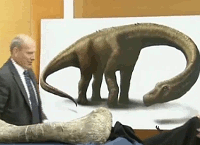

 Dinosaur hunters mix science and outdoor adventure. Find another cool job in the news and tell what's appealing.
 Look for any other science story and summarize what you learn.
 Now find coverage of something else related to a university and list one or more key points.
It's not often that scientists say they've found a new dinosaur, so last week's announcement is a big deal -- in all ways. At 85 feet long and with a weight estimated at 65 tons, it’s the largest prehistoric animal ever discovered. "Everything about this dinosaur is giant," says Professor Kenneth Lacovara at Drexel University in Philadelphia. "The femur (thigh bone) is six feet tall. The upper arm bone, the humorous, is almost as tall as I am. The tail bones are gargantuan. . . . It is by far the best example we have of any of the most giant creatures to ever walk the planet." He led a team that spent four years unearthing nearly half its skeleton in the Patagonia region of southern Argentina, where the vegetarian beast lived approximately 77 million years ago. The natural science professor explains why he chose name Dreadnoughtus, meaning "no dread" or fear: "With a body the size of a house, the weight of a herd of elephants and a weaponized tail, Dreadnoughtus would have feared nothing. It's time the herbivores (plant-eaters) get their due for being the toughest creatures in an environment." The discovery led a Utah fossil hunter, author-blogger Brian Switek, to reflect on the ageless appeal of these prehistoric beasts. "We're constantly considering dinosaurs in relation to ourselves and the world we know," he writes in a newspaper essay. "Dinosaurs embody the drastic changes that life on Earth has undergone, and give us access to some of the most powerful truths our species has come to understand – that our planet has an incredibly deep history, that life has changed constantly through time."
Front Page Talking Points is written by
Alan Stamm for NIEonline.com, Copyright 2026
Front Page Talking Points Archive►Scientists fear impact of ocean monitoring retreat by Trump administration ►How to enjoy summer break safely at beaches, trails, pools and on the road if you drive ►Deadly Ebola outbreak in Africa affects travel to the United States, including for World Cup ►Communities Push Back Against Massive AI Data Centers ►Script handwriting comeback: 2 more states now require school penmanship lessons ►U.S. health secretary changes tone on childhood measles shots ►‘Our Power, Our Planet:’ Earth Day brings reminder of need to protect Earth from ourselves ►Federal case brings verdict that Live Nation and Ticketmaster illegally overcharge concert fans ►An El Niño weather system expected this summer or fall could affect the U.S. ►Artemis II this week takes four astronauts farther from Earth than anyone has traveled |
 Finder says: "It weighed as much as a dozen African elephants or more than seven T. rex. . . . You have this 37-foot-long neck balanced by a 30-foot-long tail." -- Ken Lacovara, associate professor of paleontology at Drexel