
Common Core State Standard
SL.CCS.1/2/3/4 Grades 6-12: An essay of a current news event is provided for discussion to encourage participation, but also inspire the use of evidence to support logical claims using the main ideas of the article. Students must analyze background information provided about a current event within the news, draw out the main ideas and key details, and review different opinions on the issue. Then, students should present their own claims using facts and analysis for support. FOR THE WEEK OF NOV. 04, 2013 Concussion risks for teen athletes raise concerns and draw closer attention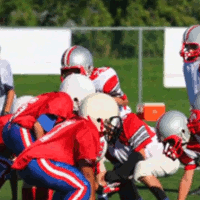

 Do any sports headlines, photos and story language seems to glorify tough physical contact?
 Find coverage of a non-contact high school or college sport. Does it have as much space or prominence as football games? Discuss or list possible reasons.
 Now look for an article about another health, fitness or recreation topic and share an interesting fact or quote.
New research adds to concerns about brain injury risks for high school athletes who play football, lacrosse baseball and soccer. Medical experts found that concussion rates are higher in high school-aged athletes who play football, baseball, men's lacrosse and men's soccer than for college athletes in those sports. For girls, soccer is the most dangerous sport. The number of patients 19 and younger treated in emergency rooms for concussions and other sports or recreation-related traumatic brain injuries rose from 150,000 in 2001 to 250,00 in 2009, says the national Institute of Medicine report. Doctors and athletic professionals have become increasingly worried in recent years about the long-term impact of sports head injuries, which can affect learning ability, memory, emotions and sleep. Young athletes usually recover from a concussion within two weeks. But in 10 to 20 percent of cases, problems persist for weeks, months or even years. The new report's authors say students may play in a "culture of resistance" that discourages them from reporting concussions or continuing with treatment plans. Some coaches push players to keep playing after a head injury, according to researchers. The 306-page study also increases pressure on helmet makers, who have sometimes suggested that their products reduce the risk of concussions. The Institute of Medicine committee sees "little evidence that current sports helmet designs reduce the risk of concussions."
Front Page Talking Points is written by
Alan Stamm for NIEonline.com, Copyright 2026
Front Page Talking Points Archive►Scientists fear impact of ocean monitoring retreat by Trump administration ►How to enjoy summer break safely at beaches, trails, pools and on the road if you drive ►Deadly Ebola outbreak in Africa affects travel to the United States, including for World Cup ►Communities Push Back Against Massive AI Data Centers ►Script handwriting comeback: 2 more states now require school penmanship lessons ►U.S. health secretary changes tone on childhood measles shots ►‘Our Power, Our Planet:’ Earth Day brings reminder of need to protect Earth from ourselves ►Federal case brings verdict that Live Nation and Ticketmaster illegally overcharge concert fans ►An El Niño weather system expected this summer or fall could affect the U.S. ►Artemis II this week takes four astronauts farther from Earth than anyone has traveled |
 Study leader says: "The findings of our report justify the concerns about sports concussions in young people. . . . We urge parents, schools, athletic departments and the public to . . . make more informed decisions about young athletes playing sports." -- Robert Graham, George Washington University in Washington, D.C.