
SL.CCS.1/2/3/4 Grades 6-12: An essay of a current news event is provided for discussion to encourage participation, but also inspire the use of evidence to support logical claims using the main ideas of the article. Students must analyze background information provided about a current event within the news, draw out the main ideas and key details, and review different opinions on the issue. Then, students should present their own claims using facts and analysis for support.
FOR THE WEEK OF FEB. 25, 2013
Studies of TV viewing in childhood show impact and suggest content matters
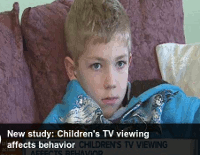



TV watching can influence young viewers' personalities for better or worse, two new studies suggest. New Zealand researchers who monitored 1,037 people there from childhood until early adulthood link heavy viewing to antisocial behavior and even crime. Every extra hour of weeknight TV watching when young increased by 30 percent the risk of a criminal conviction by age 26, they write.
In a one-year U.S. study, University of Washington researchers split 565 Seattle-area families with children ages 3 to 5 into two groups. One set of children could watch television as they usually did, while the other group was steered toward programs that feature nonviolent conflict resolution, cooperative problem solving, manners and empathy. Such shows include "Dora the Explorer," "Sesame Street," "My Friend Rabbit," "Wonder Pets!" and "Super Why." Both groups of children were evaluated later for social skills. The second bunch showed "significant improvements" by displaying less aggression and selfishness.
Rather than advising parents to limit daily viewing to two hours or less, some pediatricians (children's doctors) now say parents should focus on the type of programs. Youngsters should be steered toward educational or socially positive shows instead of those with violence and aggression. "If the screens are going to be on, let's concentrate on the content and how we can make it work for children," explains Dr. Claire McCarthy of Boston Children's Hospital.
 Professor says: "It’s not just about turning off the TV. It’s about changing the channel." – Dr. Dimitri Christakis of the University of Washington, lead author of the Seattle study
Doctor says: "With our society of smartphones and YouTube and video streaming, screen time is becoming more a part of daily life, not less." -- Dr. Claire McCarthy, Boston Children's Hospital
Crime connection: "Young adults who had spent more time watching television during childhood and adolescence were significantly more likely to have a criminal conviction, a diagnosis of antisocial personality disorder and more aggressive personality traits compared with those who viewed less television." -- Lindsay Robertson, public health researcher and lead author of New Zealand study
Front Page Talking Points Archive
►Scientists fear impact of ocean monitoring retreat by Trump administration
►How to enjoy summer break safely at beaches, trails, pools and on the road if you drive
►Deadly Ebola outbreak in Africa affects travel to the United States, including for World Cup
►Communities Push Back Against Massive AI Data Centers
►Script handwriting comeback: 2 more states now require school penmanship lessons
►U.S. health secretary changes tone on childhood measles shots
►‘Our Power, Our Planet:’ Earth Day brings reminder of need to protect Earth from ourselves
►Federal case brings verdict that Live Nation and Ticketmaster illegally overcharge concert fans
►An El Niño weather system expected this summer or fall could affect the U.S.
►Artemis II this week takes four astronauts farther from Earth than anyone has traveled