
SL.CCS.1/2/3/4 Grades 6-12: An essay of a current news event is provided for discussion to encourage participation, but also inspire the use of evidence to support logical claims using the main ideas of the article. Students must analyze background information provided about a current event within the news, draw out the main ideas and key details, and review different opinions on the issue. Then, students should present their own claims using facts and analysis for support.
FOR THE WEEK OF MAY 13, 2013
Northeast braces for noisy invasion: Flying cicada bugs return after hiding for 17 years
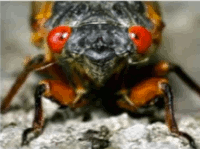



There's a buzz of talk about pesky insects that make a buzzing sound for real. They're known as cicadas (pronounced sih-KAY-duhz) -- 1 1/2-inch-long, slow-flying bugs with dark bodies and red eyes. Male cicadas are the noisy ones, sounding like a grass trimmer as they call to females. Scientists say the noise can reach 90 decibels — the same level as a lawnmower.
Unlike ordinary cicadas seen occasionally in mid-summer, these ones appear just once every 17 years along the East Coast. This year's have been underground since 1996, shortly after they hatched from eggs, squirmed into the dirt and began sucking fluid from tree roots. Now they're ready to produce the next generation. They'll emerge in states from North Carolina to Connecticut by early June, once the soil temperature reaches 64 degrees. Rare sightings have been reported as far west as Nebraska and central Kansas.
Some areas could have a couple million cicadas per street. (Yes, you read that right!) They don't bite or sting, but trees could lose small branches as they munch on leaves. For animals, they're a flying snack that's rich in protein. Birds, mice, raccoons, opossums and other animals eat cicadas. The spectacle, or nuisance, won't last long. Adults live only four to six weeks. But their 17-year life span after hatching makes them the longest-lived insects known.
 Expert says: "They can't hurt you in any way. And they don't hurt animals." -- Dan Babbitt, insect specialist at the National Museum of Natural History in Washington, D.C.
Writer says: "Adult males are snapping rigid plates on their abdomens to produce their courtship song. The females are clicking their wings to signal approval." – Carl Zimmer, New York Times science columnist
Professor says: "We're talking about a boatload of cicadas. There could be as many as a billion cicadas per square mile." – Michael Raupp, University of Maryland
Front Page Talking Points Archive
►Scientists fear impact of ocean monitoring retreat by Trump administration
►How to enjoy summer break safely at beaches, trails, pools and on the road if you drive
►Deadly Ebola outbreak in Africa affects travel to the United States, including for World Cup
►Communities Push Back Against Massive AI Data Centers
►Script handwriting comeback: 2 more states now require school penmanship lessons
►U.S. health secretary changes tone on childhood measles shots
►‘Our Power, Our Planet:’ Earth Day brings reminder of need to protect Earth from ourselves
►Federal case brings verdict that Live Nation and Ticketmaster illegally overcharge concert fans
►An El Niño weather system expected this summer or fall could affect the U.S.
►Artemis II this week takes four astronauts farther from Earth than anyone has traveled