
SL.CCS.1/2/3/4 Grades 6-12: An essay of a current news event is provided for discussion to encourage participation, but also inspire the use of evidence to support logical claims using the main ideas of the article. Students must analyze background information provided about a current event within the news, draw out the main ideas and key details, and review different opinions on the issue. Then, students should present their own claims using facts and analysis for support.
FOR THE WEEK OF SEP. 29, 2014
Millions of miles from Earth, a U.S. spacecraft orbits Mars to explore its atmosphere
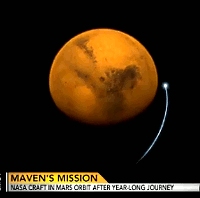



NASA doesn’t launch shuttles or blast astronauts into space right now, but it's not idle. A spacecraft called MAVEN began orbiting Mars last week after a 442-million-mile trip that took 10 months. The robotic explorer, which won't land, will use eight instruments to study the red planet's upper atmosphere for at least one year "to answer some fundamental questions about Mars and life beyond Earth." the space agency says.
Data and images are transmitted back to scientists, who're looking for clues about how Earth's neighbor went from being warm and wet billions of years ago to cold and dry. That early wet world may have harbored living microbes. Another American craft, the Curiosity rover, has been exploring the surface of Mars since August 2012. Its main objective is to determine whether the environment could have been habitable to microorganisms. That answer is yes, findings confirm.
The new probe's name is short for Mars Atmosphere and Volatile Evolution Mission. It's as long as a school bus, from solar wingtip to tip, and as heavy as an SUV. NASA has a goal of sending astronauts to Mars in the 2030s – if Congress sets aside enough public money for that ambitious, costly venture. The current mission is part of an effort “to understand everything about Mars that we need to for humans to be able to land safely on Mars, and be able to explore and journey around the planet," says Jim Green, the agency's director of planetary science.
 Astronaut says: "NASA has a long history of scientific discovery at Mars and the safe arrival of MAVEN opens another chapter." -- John Grunsfeld, astronaut and associate administrator at NASA
Mission scientist says: "I don't have any fingernails any more, but we've made it. It's incredible." -- Colleen Hartman, deputy director for science at Goddard Space Flight Center in Greenbelt, Md., speaking after the orbit began Sept. 21
Past missions: In the 1970s, NASA began landing spacecraft on Mars. In the 1990s, wheeled robots started exploring the planet's surface.
Front Page Talking Points Archive
►Scientists fear impact of ocean monitoring retreat by Trump administration
►How to enjoy summer break safely at beaches, trails, pools and on the road if you drive
►Deadly Ebola outbreak in Africa affects travel to the United States, including for World Cup
►Communities Push Back Against Massive AI Data Centers
►Script handwriting comeback: 2 more states now require school penmanship lessons
►U.S. health secretary changes tone on childhood measles shots
►‘Our Power, Our Planet:’ Earth Day brings reminder of need to protect Earth from ourselves
►Federal case brings verdict that Live Nation and Ticketmaster illegally overcharge concert fans
►An El Niño weather system expected this summer or fall could affect the U.S.
►Artemis II this week takes four astronauts farther from Earth than anyone has traveled