
Common Core State Standard
SL.CCS.1/2/3/4 Grades 6-12: An essay of a current news event is provided for discussion to encourage participation, but also inspire the use of evidence to support logical claims using the main ideas of the article. Students must analyze background information provided about a current event within the news, draw out the main ideas and key details, and review different opinions on the issue. Then, students should present their own claims using facts and analysis for support. FOR THE WEEK OF JAN. 10, 2011 Word change in Mark Twain books revives debate about literature, language, race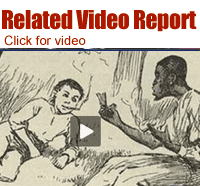

 Find a news or feature presentation illustrating how race relations in 2011 are far different than when Twain wrote.
 List or discuss differences between language in newspapers and literature. Why should or shouldn't this paper print the n-word?
 Predicting what offends can be tricky. Does any ad, photo, editorial cartoon or opinion column upset you or seem as though it could appear crude to others?
"The difference between the almost right word and the right word is really a large matter," according to 19th century author Mark Twain. "It is the difference between the lightning bug and the lightning." Now his best-known books, The Adventures of Huckleberry Finn and The Adventures of Tom Sawyer, are the focus of heated debate over whether a racial slur is the right word for students and others to see. NewSouth Books, accepting advice from a 69-year-old English professor, says the change is intended to avoid offending readers. The 7,500-copy edition also replaces "injun" with "Indian." In its attempt to avoid offending readers, the publisher offended literature scholars, online commentators and Twain admirers of all ages. "Who knows what other words [Huck Finn] contains that are OK now that someday might be offensive?" Comedy Central TV host Stephen Colbert asked sarcastically.
The acclaimed author would recognize the current hullabaloo. The year Huck Finn appeared, the Concord Public Library in Massachusetts banned it for "coarse language." A reviewer called it "the veriest trash ... more suited to the slums than to intelligent, respectable people." In 1905, the Brooklyn Public Library in New York banished the book from its young readers' section. School boards and superintendents in some areas still fussed over it from time to time, and in 1998 parents sued a high school in Tempe, Ariz., to keep the book off a required reading list. They lost at a federal appeals court.
Multisource political news, world news, and entertainment news analysis by Newsy.com Front Page Talking Points is written by
Felix Grabowski and Alan Stamm for NIEonline.com, Copyright 2026
Front Page Talking Points Archive►Social media giants lose two lawsuits blaming them for serious risks to young users ►Wartime news reports fuel fresh strains between U.S. government and the media ►Iran war blocks key Mideast tanker route, pushing up oil prices and endangering global economies ►Measles outbreaks in 30 states reinforce value of childhood vaccines ►U.S. military strikes on Iran bring counter-attacks and congressional pushback ►'The digital Wild West:' Teen social media limits spread in Europe ►Winter Games: Elite athletes show Olympic medal-winning skills in Italy ►Reporters' arrest in Minneapolis church protest raises press freedom issue ►NASA prepares for return to the moon, starting with an orbital mission by four astronauts |
 Change backer says: "It's such a shame that one word should be a barrier between a marvelous reading experience and a lot of readers." -- Alan Gribben, English professor at Auburn University in Alabama, who advised publisher to change text

