
Common Core State Standard
SL.CCS.1/2/3/4 Grades 6-12: An essay of a current news event is provided for discussion to encourage participation, but also inspire the use of evidence to support logical claims using the main ideas of the article. Students must analyze background information provided about a current event within the news, draw out the main ideas and key details, and review different opinions on the issue. Then, students should present their own claims using facts and analysis for support. FOR THE WEEK OF DEC. 02, 2013 Ancient comet that circled the sun could create a bright sky show here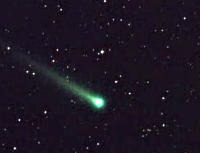

 Find other science or technology coverage of interest and summarize what’s cool or interesting.
 Identify an article or photo about something that doesn’t seem scientific, but actually involves chemistry, biology, medical science or earth science.
 Can you find a quote or photo from someone with a job that required training in at least one STEM (science, technology, engineering, math) subject?
Something special happened far above Earth on Thanksgiving, captivating astronomers. It may sound like a sci-fi movie, but is a real-life phenomenon: A comet that's over 4 billion years old spun around the sun and emerged on the other side as if propelled from a slingshot. Spacecraft from NASA and the European Space Agency watched the ancient comet, named ISON by scientists, plunge toward the sun. Its tail has been visible for a while, and some parts apparently survived last Thursday's hot close encounter. It could put on a spectacular, multi-week sky show in our Northern Hemisphere. Comets are giant snowballs of frozen gases, rock and dust that come from the solar system's edge and can be several miles in diameter. When they get close enough to see, scientists study them for clues about how our solar system formed. "It now looks like some chunk of ISON's nucleus has indeed made it through the solar corona," Karl Battams of the Naval Research Laboratory said a day after Thanksgiving. "Now that it has emerged and started to brighten, we need to observe it for a few days to get a feel for its behavior." "It certainly appears as if there is an object there that is emitting material," says Alan Fitzsimmons, an astronomer in Northern Ireland who specializes in comets and asteroids (more solid space rocks that have no tail). "This is what makes science interesting. If we knew what was going to happen, it wouldn't be interesting." A smaller comet named Lovejoy grazed the sun and survived in 2011, but fell apart a couple of days later.
Front Page Talking Points is written by
Alan Stamm for NIEonline.com, Copyright 2026
Front Page Talking Points Archive►Social media giants lose two lawsuits blaming them for serious risks to young users ►Wartime news reports fuel fresh strains between U.S. government and the media ►Iran war blocks key Mideast tanker route, pushing up oil prices and endangering global economies ►Measles outbreaks in 30 states reinforce value of childhood vaccines ►U.S. military strikes on Iran bring counter-attacks and congressional pushback ►'The digital Wild West:' Teen social media limits spread in Europe ►Winter Games: Elite athletes show Olympic medal-winning skills in Italy ►Reporters' arrest in Minneapolis church protest raises press freedom issue ►NASA prepares for return to the moon, starting with an orbital mission by four astronauts |
 Explaining the name: Two Russian astronomers first spotted Comet ISON in September 2012 and named it after their night-sky survey program, the International Scientific Optical Network -- observatories in 10 countries that track objects in space

