
Common Core State Standard
SL.CCS.1/2/3/4 Grades 6-12: An essay of a current news event is provided for discussion to encourage participation, but also inspire the use of evidence to support logical claims using the main ideas of the article. Students must analyze background information provided about a current event within the news, draw out the main ideas and key details, and review different opinions on the issue. Then, students should present their own claims using facts and analysis for support. FOR THE WEEK OF MAY 05, 2014 Nature’s fury: Tornadoes reshape landscape and lives across the South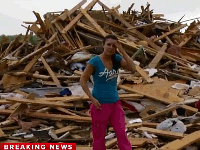

 Are tornadoes making news again this week? If so, where?
 Find other news related to the weather or nature and tell who’s affected or could be.
 Now look for a photo showing a spring scene.
A series of strong twisters brought death and destruction to parts of the South and Midwest last week as violent weather pulverized homes in half a dozen states from Iowa to Tennessee. At least three dozen deaths were reported from as many as 90 tornadoes. Damaged buildings include a hospital in Louisville, Miss., where winds knocked down two walls and tore holes in the roof. Wind speeds in Tennessee reportedly exceeded 190 mph. "All homes gone" said a National Weather Service bulletin for a community in Lincoln County, Tenn. President Obama declared a major disaster in Arkansas and ordered federal aid to supplement state and local recovery efforts in a county hit by tornadoes, other severe storms and flooding. Later in the week, heavy rain flooded parts of Florida's Panhandle and Alabama. Nearly 2 feet of rain fell in about 24 hours, knocking out power and causing damage in Escambia and Santa Rosa counties in this state. Some people were rescued from rooftops. A tornado is a violently rotating column of air that emerges from what;s called a supercell thunderstorm. When cold, dry air pockets in the upper atmosphere meet humid, warm air below, that raises the risk of tornadoes – which typically occur in spring. "We're on a part of the planet where these ingredients can come together sometimes very quickly," says weather expert Ernest Agee, a professor at Purdue University in Indiana. "Other places have tornadoes, but not as many." Twisters extend between the ground and a cloud, usually a cumulonimbus cloud. Most last for less than 10 minutes, though large ones can spin a half-hour. They can be more than two miles wide and race across land for dozens of miles.
Front Page Talking Points is written by
Alan Stamm for NIEonline.com, Copyright 2026
Front Page Talking Points Archive►Social media giants lose two lawsuits blaming them for serious risks to young users ►Wartime news reports fuel fresh strains between U.S. government and the media ►Iran war blocks key Mideast tanker route, pushing up oil prices and endangering global economies ►Measles outbreaks in 30 states reinforce value of childhood vaccines ►U.S. military strikes on Iran bring counter-attacks and congressional pushback ►'The digital Wild West:' Teen social media limits spread in Europe ►Winter Games: Elite athletes show Olympic medal-winning skills in Italy ►Reporters' arrest in Minneapolis church protest raises press freedom issue ►NASA prepares for return to the moon, starting with an orbital mission by four astronauts |
 Presidential message: "Your country will be there to help you recover and rebuild as long as it takes."

